
Radiation oncologist in Delhi: when you need one and how it differs
Understanding the difference between medical and radiation oncology before you choose your care team
This page is for informational purposes only and does not replace medical advice. Please consult Dr Aditya Sarin or a qualified oncologist to understand which specialists your specific diagnosis actually requires. As of 2026, this reflects current clinical guidance.
If you or someone close to you has just been diagnosed with cancer, you’ve probably already run into a confusing wall of job titles. Medical oncologist. Radiation oncologist. Surgical oncologist. They all sound similar, but they do genuinely different jobs, and knowing which one you need, and when, can save you a lot of confused phone calls. Here’s what a radiation oncologist actually does, how that differs from a medical oncologist, and how the two work together on an actual treatment plan.
What does a radiation oncologist do
A radiation oncologist is a doctor who specialises in treating cancer using high-energy radiation to destroy cancer cells or shrink tumours. According to the National Cancer Institute, radiation therapy works by damaging the DNA inside cancer cells so they can no longer grow or divide.
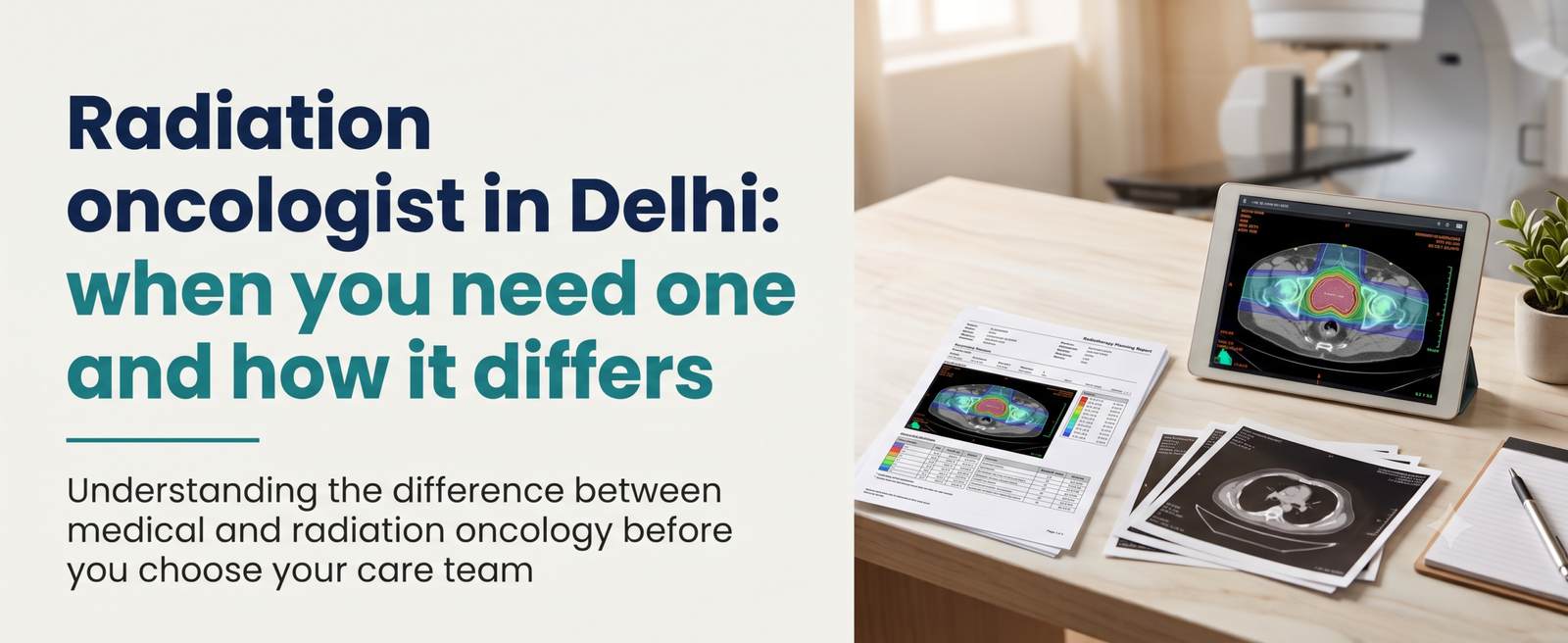
Radiation oncologists don’t just point a machine and press a button. They work with a medical physicist and a radiation therapist to plan exactly how much radiation to give, from what angles, and over how many sessions, so the tumour gets the dose it needs while sparing healthy surrounding tissue as much as possible.
What does a medical oncologist do
A medical oncologist treats cancer with medicines that work throughout the body, including chemotherapy, hormone therapy, targeted therapy, and immunotherapy. According to Maryland Oncology Haematology, a medical oncologist often serves as the primary point of contact for a cancer patient, coordinating care and managing side effects across the entire treatment journey, not just one phase.
This is the role Dr Aditya Sarin practices in. His work centres on diagnosing cancer, interpreting biomarker and genetic test results, and building a systemic treatment plan, whether that’s chemotherapy, targeted therapy, or immunotherapy, tailored to a patient’s specific tumour biology.
Medical oncologist vs radiation oncologist: The core difference
The simplest way to think about it: a medical oncologist treats cancer with medicine that travels through the body, while a radiation oncologist treats a specific, defined area with focused radiation. Neither approach is inherently stronger or weaker. They target the disease differently, and which one, or which combination, makes sense depends entirely on the cancer type, its stage, and where it is in the body.
According to Acibadem Hospitals Group, these specialities aren’t in competition with each other. In most real-world cancer care, a patient sees more than one type of oncologist, and the treatment plan is built as a coordinated effort between them, not a choice between two separate paths.
Side effects also differ. Medical oncology treatments can affect the whole body depending on the drug involved, while radiation side effects are usually limited to the treated area, though they still vary depending on where that area is.
When do you actually need a radiation oncologist
Not every cancer diagnosis calls for radiation, and that’s an important thing to understand upfront rather than assuming every patient’s team looks the same. Radiation is generally considered when one or more of the following applies.
The cancer is confined to a specific, localised area, which makes it a good candidate for focused treatment rather than a whole-body approach.
Surgery has removed a visible tumour, but there’s a meaningful risk of microscopic cancer cells remaining nearby, in which case radiation is used afterwards to reduce the chance of recurrence.
The tumour needs to be shrunk before surgery to make the operation more feasible or less extensive.
The goal is symptom relief rather than cure, such as easing pain from a tumour that has spread to bone, where radiation can meaningfully improve quality of life even in advanced disease.
Cancers of the head and neck, breast, cervix, prostate, and certain blood cancers like lymphoma commonly involve radiation as part of the overall plan, according to the National Cancer Institute, though the exact role varies by case.
The main types of radiation therapy
Radiation therapy isn’t one single technique. The two broad categories are external beam radiation therapy, delivered from a machine outside the body and the most widely used approach, and brachytherapy, sometimes called internal radiation, where a radioactive source is placed directly inside or next to the tumour. Brachytherapy is used most often for cancers of the head and neck, breast, cervix, and prostate.
There are also systemic forms of radiation therapy, such as radioactive iodine for certain thyroid cancers, that work more like a targeted internal treatment than a localised beam.
For most people, radiation isn’t a stand-alone treatment. It’s typically combined with surgery, chemotherapy, or immunotherapy, and a medical oncologist helps coordinate that across the full course of care.
How a medical oncologist and radiation oncologist work together
In practice, cancer care rarely comes down to one specialist working in isolation. A patient with breast cancer, for example, might see a surgeon to remove the tumour, a radiation oncologist for follow-up radiation to the chest wall, and a medical oncologist managing hormone therapy or chemotherapy over the following months, all as part of one coordinated plan. The same layered approach applies to cervical cancer, where chemotherapy and radiation are frequently used together, and to several throat cancer cases, where radiation, surgery, and systemic therapy are often combined.
According to ASCO Connection, the American Society of Clinical Oncology’s own platform, modern cancer care runs on multidisciplinary teams where medical oncologists, radiation oncologists, and other specialists each bring a different role to a patient’s case. Rather than patients choosing between them, a coordinated, jointly reviewed treatment plan is generally considered the standard of care.
Where does a medical oncologist fit into this decision?
If you’re newly diagnosed and unsure who to see first, a medical oncologist is often the right starting point. Because the role involves coordinating the broader treatment plan and interpreting diagnostic and biomarker results, a medical oncologist can help determine whether radiation, chemotherapy, targeted therapy, surgery, or some combination is the right path, and refer you to the appropriate specialists accordingly, rather than you needing to guess which type of oncologist to book first.
A second opinion can also be genuinely useful, particularly if you’ve already been told you need radiation and want an independent review of whether that’s the most appropriate next step given your specific diagnosis and stage.
The takeaway
Medical and radiation oncology aren’t competing paths; they’re complementary parts of modern cancer care, and most patients benefit from both being involved at the right point in treatment. If you’ve been diagnosed and aren’t sure which specialists your case actually needs, book a consultation with Dr Aditya Sarin to get a clear, coordinated starting point for your treatment plan.
References
- National Cancer Institute: Radiation Therapy for Cancer
- Maryland Oncology Haematology: Understanding Your Cancer Care Team
- ASCO Connection, American Society of Clinical Oncology: Contemporary Clinical Oncology Training in the United States: Is Radiation or Medical Oncology Right for You?.