
Home » Best cancer specialist in Delhi: How to choose the right oncologist
Summary
Choosing the right cancer specialist in Delhi NCR is confusing because most patients start with a diagnosis or a referral, not a plan. Cancer treatment rarely involves one doctor, so the right specialist depends on the cancer type, stage, and treatment approach. This guide breaks down the different types of oncologists, what to check when picking a hospital, and how a personalized, genomics-led treatment approach differs from standard protocols — so patients can make an informed choice instead of a rushed one.
What types of specialists treat cancer?
Cancer treatment typically involves a team of specialists rather than a single doctor, with the exact combination depending on the cancer type and stage.
Specialist type | Primary role | When typically needed |
Medical oncologist | Chemotherapy, immunotherapy, targeted therapy | Usually the primary doctor for most cancer treatments |
Surgical oncologist | Tumor removal and cancer-related surgery | When the cancer is operable |
Radiation oncologist | Radiation therapy | Often combined with chemotherapy or surgery |
A medical oncologist is usually the doctor who coordinates the overall treatment plan, even when surgery or radiation is also involved.
Who is Dr Aditya Sarin?
Dr Aditya Sarin is a medical oncologist based in Delhi NCR, known for his work in precision oncology and personalized cancer treatment. His areas of expertise include immunotherapy, targeted therapy, and tumor genetic profiling, with particular focus on breast, lung, gastrointestinal, and head and neck cancers.
His treatment approach follows three principles.
- Genomic testing before selecting a treatment protocol.
- Personalized therapy planning based on the patient’s specific tumor profile.
- Avoiding treatments unlikely to be effective for the individual case.
This approach reflects a broader shift in oncology towards genomics-led treatment rather than a uniform protocol applied to every patient with the same cancer type. You can read more about his background on the About Dr Aditya Sarin page.
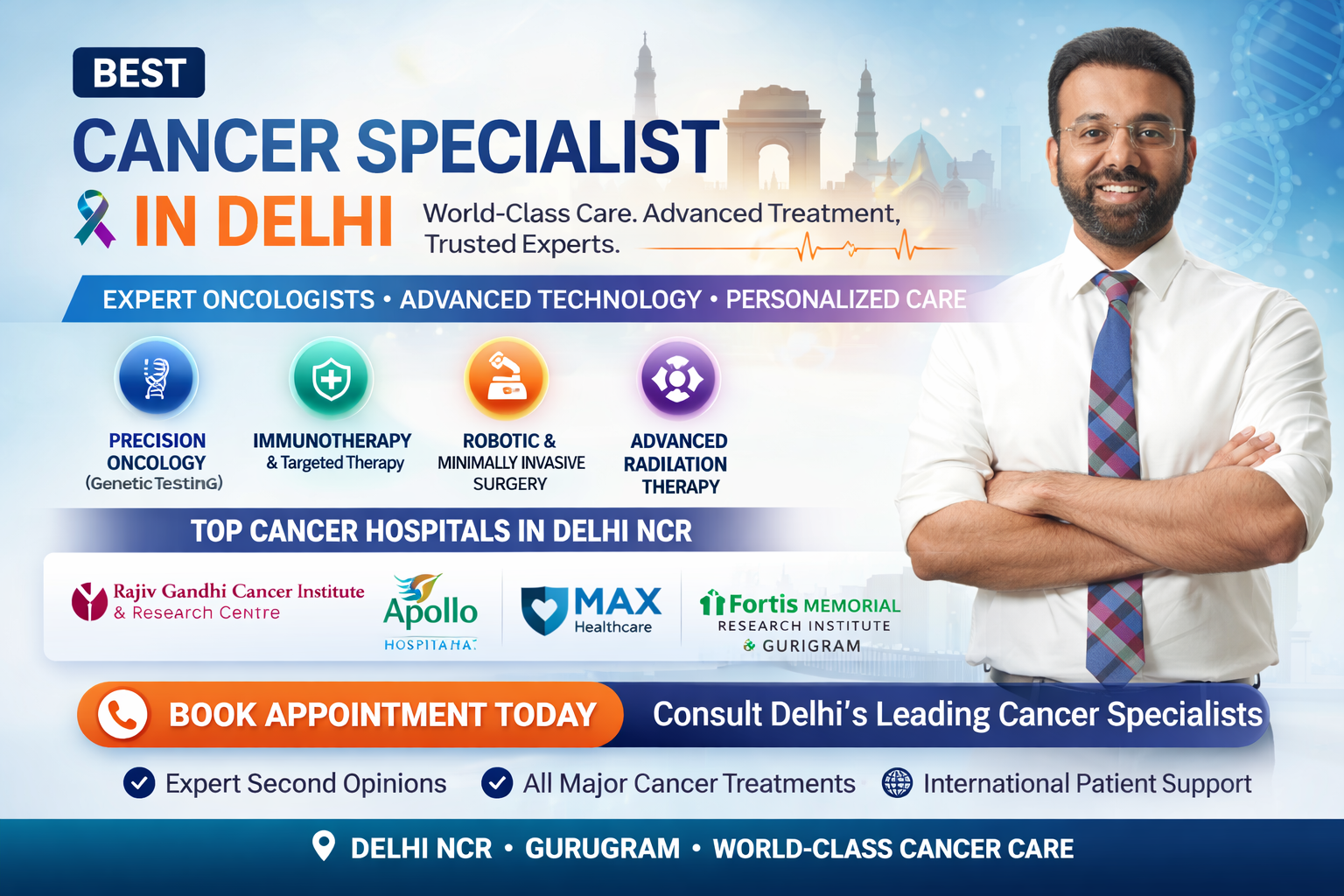
Which are the top cancer hospitals in Delhi NCR?
Delhi NCR has several hospitals with dedicated oncology infrastructure, each with a different area of strength.
Hospital | Known for |
Rajiv Gandhi Cancer Institute and Research Center | Dedicated cancer hospital with strong radiation and medical oncology expertise |
Indraprastha Apollo Hospital | Advanced oncology infrastructure and multidisciplinary tumor board approach |
Max Super Specialty Hospital | Comprehensive cancer care with strong surgical oncology support |
Fortis Memorial Research Institute, Gurgaon | Advanced diagnostics and targeted therapy protocols |
The choice of hospital often matters as much as the choice of doctor, particularly for complex cases that require surgery, radiation, and systemic treatment in the same location.
What advanced cancer treatments are available in Delhi?
Immunotherapy works by helping the immune system identify and destroy cancer cells, and it is increasingly used alongside or instead of chemotherapy for eligible patients. The National Cancer Institute provides a detailed overview of how different types of immunotherapy work.
Targeted therapy focuses on specific mutations within cancer cells, which can reduce damage to healthy tissue compared to conventional chemotherapy.
Precision oncology uses genetic profiling of a patient’s tumor to design a personalized treatment plan, an approach used by specialists such as Dr Aditya Sarin. The National Cancer Institute’s precision medicine program outlines how this genetic-matching approach is applied in practice.
Minimally invasive and robotic-assisted surgical techniques are associated with faster recovery and improved surgical precision compared to traditional open surgery.
How should you choose the right cancer specialist?
Choosing the right cancer specialist comes down to matching the doctor’s expertise, the hospital’s infrastructure, and the treatment approach to the specific case.
- Match the specialist to the cancer type, since oncologists often focus on particular cancers or treatment methods.
- Evaluate hospital infrastructure, including ICU access, diagnostic capability, and availability of advanced therapies.
- Understand whether the treatment approach follows standard protocols or incorporates personalized, genomics-led planning.
- Consider a second opinion for major or complex cases, which is a widely recommended practice in oncology.
The takeaway
There is no single best cancer specialist for every patient. The right choice depends on the cancer type, the stage at diagnosis, and the treatment approach that fits the individual case. Delhi NCR gives patients access to a strong combination of specialists and hospital infrastructure, and to personalized, genomics-led care from specialists such as Dr Aditya Sarin, which is increasingly shaping how complex cases are managed.
If you or a family member are exploring treatment options, the next right step is a conversation, not a delay. You can book a consultation with Dr Aditya Sarin to discuss a personalized evaluation of your case.
Frequently Asked Questions
Which is the best cancer hospital in Delhi?
Leading options include Rajiv Gandhi Cancer Institute, Indraprastha Apollo Hospital, Max Super Specialty Hospital, and Fortis Memorial Research Institute. The right choice depends on the type of cancer and the treatment required.
Who is the best cancer specialist in Delhi?
The right specialist depends on the cancer type and stage. Oncologists such as Dr Aditya Sarin are known for personalized, genomics-led treatment approaches.
Is immunotherapy available in Delhi?
Yes, immunotherapy and targeted therapy are available at most leading cancer hospitals in Delhi-NCR, though eligibility depends on the cancer type and tumor profile.
Do I need a referral to see a medical oncologist?
Not always. Many patients consult a medical oncologist directly after a suspicious finding on a scan or biopsy, though a referral from a general physician is also common.

Dr. Aditya Sarin
Consultant, Medical Oncology · Sir Ganga Ram Hospital, New Delhi
MD (General Medicine) · DrNB (Medical Oncology) · ESMO (European) Board Certified
Dr. Aditya Sarin is a medical oncologist who combines precision molecular profiling with evidence-based, compassionate cancer care. Named Young Medical Oncologist of the Year, he treats the full spectrum of solid and blood cancers through a multidisciplinary tumor-board approach at Sir Ganga Ram Hospital.