
Header
Sir Ganga Ram Hospital, New Delhi

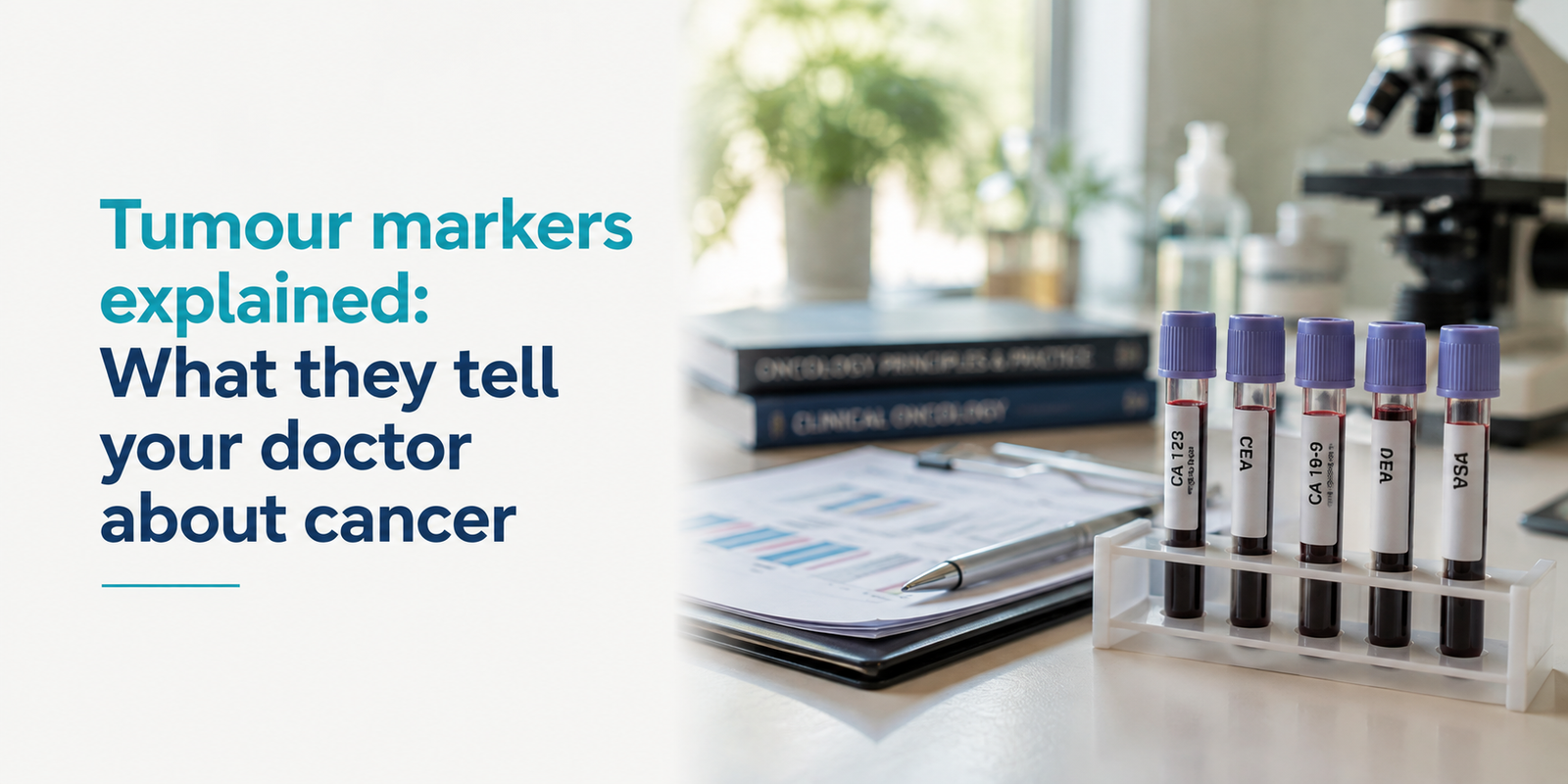
Tumour markers explained: What they tell your doctor about cancer

A plain-language guide to CA 125, CEA, and the blood tests behind your cancer care

This page is for informational purposes only and does not replace medical advice. Please consult Dr Aditya Sarin or a qualified oncologist to understand what your specific tumour marker results mean. As of 2026, this reflects current clinical guidance.

If you’ve had bloodwork done as part of a cancer diagnosis, you’ve probably seen a result labelled CA 125 or CEA and had no idea what it actually meant. Tumour markers show up on a lot of lab reports, but they’re rarely explained well. Here’s what they are, what the common ones actually track, and where they fit into an actual treatment plan.


What is a tumour marker?

A tumour marker is a substance, usually a protein, found in blood, urine, or tissue that can be elevated when cancer is present. According to the National Cancer Institute, tumour markers are mainly used to help diagnose cancer, guide treatment decisions, and monitor how well a treatment is working, not to screen healthy people for cancer in most cases.

That last part matters. Tumour markers aren’t a stand-alone way to find cancer early. With the exception of PSA for prostate cancer, most markers don’t have the accuracy needed for population screening. They’re better understood as one piece of a larger picture that includes imaging, biopsy, and clinical evaluation.


What are the main types of tumour markers?

There are dozens of tumour markers in clinical use, but a handful come up constantly. Each is associated with certain cancer types, though none is exclusive to just one.

CA 125 is most closely linked to ovarian cancer. It’s elevated in roughly 80 per cent of ovarian cancer cases, but it also rises with completely unrelated things like endometriosis, pregnancy, and menstruation, so a high result alone doesn’t confirm cancer.

CEA, or carcinoembryonic antigen, is used primarily to monitor colorectal cancer, both to track treatment response and to catch recurrence after surgery. It’s not used to diagnose colon cancer in the first place, since plenty of non-cancerous conditions, including smoking, can raise it too.

CA 19-9 is associated mainly with pancreatic cancer and is also used in some gastrointestinal cancers. It helps distinguish the nature of a pancreatic mass and track how treatment is going.

AFP, or alpha-fetoprotein, is the main marker for liver cancer and is also used for certain testicular cancers.

PSA is specific to prostate cancer and is the one marker sensitive enough to be used in actual screening programs, though even PSA has known limitations around false positives.

CA 15-3 and CA 27-29 are used mainly to monitor treatment response in metastatic breast cancer, not for initial diagnosis.


What does a tumour marker blood test actually show

A tumour marker test measures the concentration of that specific substance in your blood at one point in time. On its own, a single number rarely tells the full story. What matters more is the trend.

If CA 125 or CEA is rising steadily over several tests, that’s a stronger signal than one high reading. If a marker drops after surgery or chemotherapy and stays low, that generally means treatment is working. If it starts climbing again after being low, that can be an early sign of recurrence, sometimes months before it would show up on a scan.

This is why oncologists tend to order these tests repeatedly through a treatment course rather than once. The pattern over time carries more information than any single result.


Can a tumour marker diagnose cancer on its own

No. This is probably the most important thing to understand about tumour markers. According to the American Cancer Society, an elevated marker can point toward cancer, but confirming a diagnosis still requires imaging and, in most cases, a biopsy.

Several conditions that have nothing to do with cancer can raise these same markers. CA 125 rises with pelvic inflammatory disease. CEA rises in smokers and with inflammatory bowel disease. A normal marker level also doesn’t rule out cancer entirely, since not every tumour produces measurable amounts of a given marker. Some ovarian cancers, for instance, never raise CA 125 at all.


Tumour marker testing in India

Tumour marker blood tests are widely available across major diagnostic labs in India and are a standard part of oncology workups at hospitals like Sir Ganga Ram Hospital. They’re typically ordered alongside imaging such as CT or PET scans rather than in isolation, which is the approach Dr Aditya Sarin follows when building a diagnostic picture for a patient. For markers tied to specific cancers, CA 125 for ovarian cancer, CEA for colorectal cancer, CA 19-9 for pancreatic cancer, or AFP for liver cancer, testing is usually combined with biomarker and genetic profiling to guide not just diagnosis but the choice between treatments like chemotherapy, targeted therapy, or immunotherapy.


The takeaway

Tumour markers are a useful piece of the puzzle, not the whole picture. They’re best at tracking trends over time and monitoring how well treatment is working, and least reliable when used alone to diagnose or rule out cancer. If you’ve got a tumour marker result you don’t understand, book a consultation to have it explained in the context of your actual case.

Dr. Aditya Sarin — Medical Oncologist, Sir Ganga Ram Hospital, Delhi
Medically reviewed & written by

Dr. Aditya Sarin

Consultant, Medical Oncology · Sir Ganga Ram Hospital, New Delhi

MD (General Medicine) · DrNB (Medical Oncology) · ESMO (European) Board Certified

Dr. Aditya Sarin is a medical oncologist who combines precision molecular profiling with evidence-based, compassionate cancer care. Named Young Medical Oncologist of the Year, he treats the full spectrum of solid and blood cancers through a multidisciplinary tumor-board approach at Sir Ganga Ram Hospital.

Breast Cancer Lung Cancer GI Cancers Head & Neck Gynecologic Cancers Immunotherapy Targeted Therapy Precision / Molecular Oncology Leukemia · Lymphoma · Myeloma

Ovarian cancer symptoms that are easy to miss, and why early detection matters

Ovarian cancer symptoms that are easy to miss, and why early detection matters

A guide to spotting the signs your body may already be giving you

This page is for informational purposes only and does not replace medical advice. If you’re experiencing any of the symptoms below, please see a gynaecologist or oncologist for proper evaluation. As of 2026, the information reflects current clinical guidance.

Ovarian cancer rarely announces itself. There’s no dramatic pain, no single red flag most women recognise right away. Instead, it shows up as bloating, a bit of pelvic discomfort, or feeling full after a small meal, things most of us would blame on stress or a bad lunch. That’s exactly why it’s often called a silent disease, and why understanding these early ovarian cancer symptoms can genuinely change the outcome.


What are the early symptoms of ovarian cancer?

The most commonly reported early symptoms are persistent bloating, pelvic or abdominal pain, feeling full quickly while eating, and needing to urinate more often or urgently. What makes these tricky isn’t the symptoms themselves. It’s the word “persistent.” A single day of bloating means nothing. Bloating that sticks around for two to three weeks, especially alongside one or two of the other signs, is worth getting checked.

Some women also notice unexplained changes in bowel habits, fatigue that doesn’t improve with rest, or unintended weight loss. Back pain and pain during intercourse can show up too, though these tend to appear a bit later.

None of these symptoms is unique to ovarian cancer on their own. A stomach bug causes bloating. Stress causes fatigue. That overlap is precisely the problem.


Why these symptoms get missed so often

Most of these signs mimic everyday digestive or menstrual complaints. A woman with bloating and a full feeling after meals is far more likely to be told it’s IBS, acid reflux, or “just hormones” than to be sent for an ovarian workup. Doctors aren’t wrong to consider common causes first. But when symptoms don’t resolve on their own timeline, that’s the signal to push further.

Only about 22 per cent of ovarian cancer cases are caught while still confined to the ovary. The rest are found after the disease has already spread, largely because both patients and, at times, doctors attribute the early signs to something more routine. This single gap, vague symptoms leading to delayed evaluation, is the biggest reason ovarian cancer has a lower survival rate than cancers like breast cancer, which has a clear screening tool in mammography.


What causes ovarian cancer

There’s no single cause, but a few factors clearly raise risk. Inherited mutations in the BRCA1 and BRCA2 genes are among the strongest, and they’re relevant to more than just risk. Tumours linked to these mutations often respond well to a class of targeted drugs called PARP inhibitors, which is one reason genetic testing at diagnosis matters, not just for family history purposes.

Age is another factor. Risk rises after menopause, and most cases are diagnosed in women over 50. A family history of ovarian, breast, or colorectal cancer, endometriosis, and never having been pregnant are also associated with somewhat higher risk. None of these guarantees anything. They simply shift the odds enough that awareness matters more for some women than others.


How is ovarian cancer diagnosed?

There’s no reliable population-wide screening test for ovarian cancer, which is different from how breast or cervical cancer works. According to the American Cancer Society, if a doctor suspects something based on symptoms, the usual next steps are a pelvic exam, a transvaginal ultrasound, and a CA-125 blood test. 

CA-125 gets mentioned a lot, so it’s worth being clear about what it actually tells you. It can be elevated with ovarian cancer, but it also rises with completely unrelated, non-cancerous conditions, and some ovarian cancers don’t raise it at all. It’s a supporting piece of the picture, not a standalone diagnostic test. If imaging and bloodwork raise concern, a biopsy confirms the diagnosis.


What are the stages of ovarian cancer?

Once diagnosed, staging tells you how far the cancer has spread and shapes everything about treatment. Stage I means the cancer is confined to one or both ovaries. Stage II means it has reached nearby pelvic organs. Stage III means it has spread beyond the pelvis to the lining of the abdomen or nearby lymph nodes. Stage IV means it has reached distant organs.

Survival is closely tied to stage at diagnosis. In the United States, five-year survival for localised disease sits around 92 per cent, compared to roughly 32 per cent once the cancer has spread to distant organs. That gap is the entire argument for taking early symptoms seriously rather than waiting them out.


Ovarian cancer treatment in India

Treatment typically combines surgery to remove as much of the tumour as possible with chemotherapy, and increasingly, targeted therapy for patients whose tumours carry specific mutations like BRCA1 or BRCA2. The right combination depends on stage, tumour type, and overall health, which is why a personalised plan matters more than a standard protocol.

Dr Aditya Sarin, a medical oncologist at Sir Ganga Ram Hospital, New Delhi, offers genetic testing and biomarker-driven treatment planning for ovarian cancer patients, so decisions around chemotherapy versus targeted therapy are based on the tumour’s actual biology rather than a one-size-fits-all approach. If you’ve already received a diagnosis elsewhere and want another set of eyes on your treatment plan, a second opinion is often worth the conversation, particularly for a cancer where treatment choices vary this much by individual case.


The takeaway

Ovarian cancer doesn’t come with an obvious warning sign, which puts the responsibility on paying attention to what’s persistent versus what’s passing. Bloating, pelvic discomfort, and early fullness that stick around for weeks aren’t things to sit on. If something feels off in your body and doesn’t resolve, book a consultation and have it checked properly.

Dr. Aditya Sarin — Medical Oncologist, Sir Ganga Ram Hospital, Delhi
Medically reviewed & written by

Dr. Aditya Sarin

Consultant, Medical Oncology · Sir Ganga Ram Hospital, New Delhi

MD (General Medicine) · DrNB (Medical Oncology) · ESMO (European) Board Certified

Dr. Aditya Sarin is a medical oncologist who combines precision molecular profiling with evidence-based, compassionate cancer care. Named Young Medical Oncologist of the Year, he treats the full spectrum of solid and blood cancers through a multidisciplinary tumor-board approach at Sir Ganga Ram Hospital.

Breast Cancer Lung Cancer GI Cancers Head & Neck Gynecologic Cancers Immunotherapy Targeted Therapy Precision / Molecular Oncology Leukemia · Lymphoma · Myeloma