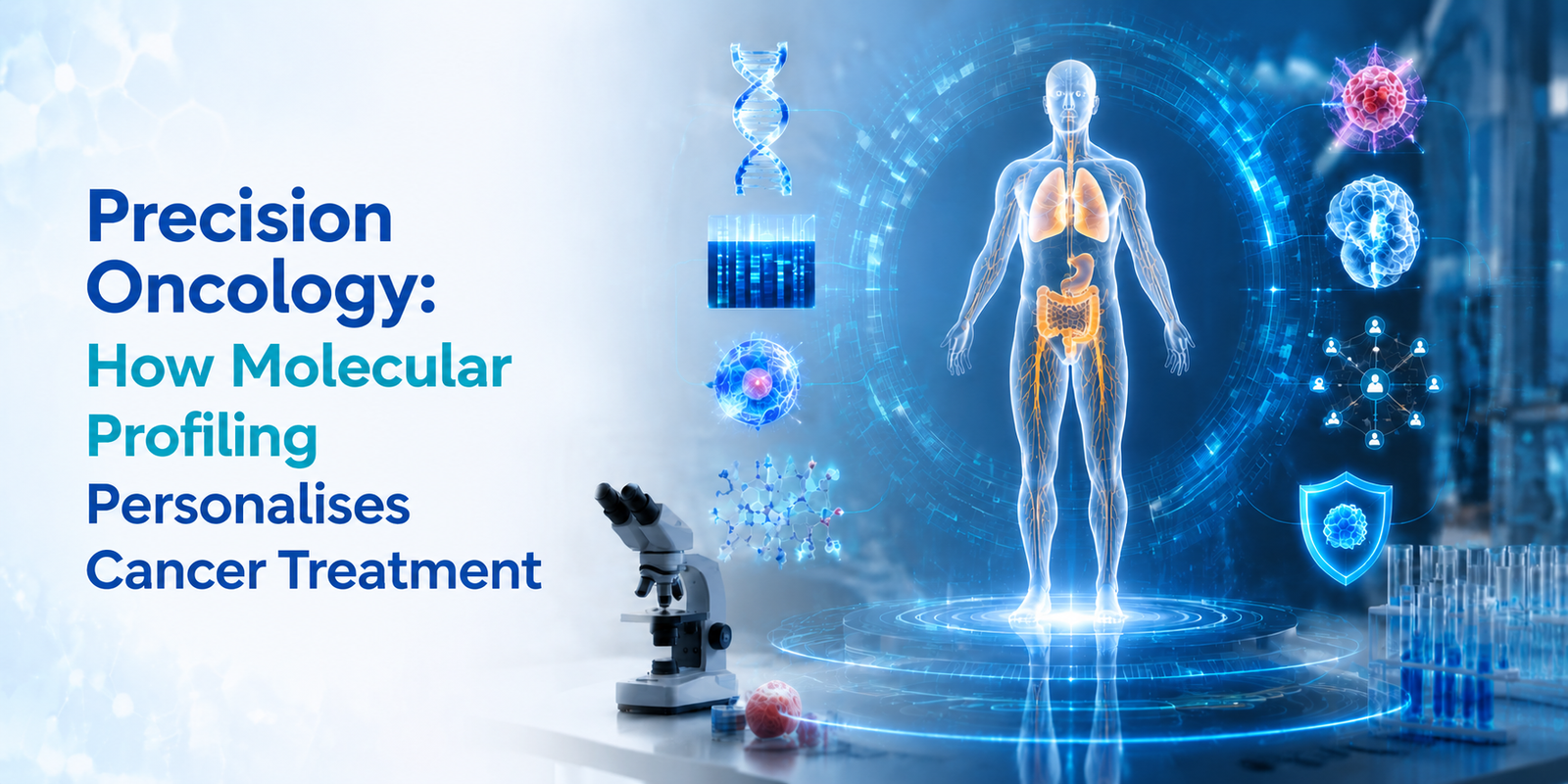
What is precision oncology?
Precision oncology is an approach to cancer treatment that uses the genetic and molecular characteristics of an individual patient’s tumour to select therapy, rather than applying a standard protocol based solely on cancer type and stage.
Instead of asking only “what kind of cancer is this,” precision oncology asks “what specific mutations and biomarkers are driving this particular tumour, and which treatments target them directly.” The result is a treatment plan built around the patient’s own tumour biology.
This approach has become central to modern oncology because tumours that look identical under a microscope can behave very differently depending on their underlying genetic drivers, and treatments that work well for one genetic profile may do little for another.
What is molecular profiling in cancer treatment?
Molecular profiling is the process of analysing a tumour’s DNA, RNA, and proteins to identify specific genetic mutations, gene fusions, and biomarkers, which then guide treatment selection.
Profiling typically starts with a tissue sample from a biopsy or surgical specimen, though a blood-based liquid biopsy is increasingly used when tissue is limited or degraded. Next-generation sequencing is the most accessible method for describing genomic alterations in cancer patients from both tumour tissue samples and circulating cell-free DNA in blood, as outlined in a clinical review of NGS applications in oncology.
The output of molecular profiling is a report identifying which mutations are present in the tumour and, where evidence exists, which approved or investigational therapies target those specific mutations. The National Cancer Institute’s overview of biomarker testing explains this process in more detail, including how results are used to guide treatment and, in some cases, clinical trial eligibility.
What is next-generation sequencing, and how does it work?
Next-generation sequencing, commonly abbreviated as NGS, is a laboratory technique that reads large numbers of genes simultaneously to detect the mutations driving a specific tumour, rather than testing one gene at a time.
NGS enables detailed genomic profiling of tumours, identifying the genetic alterations that drive cancer progression and facilitating personalised treatment plans targeted to specific mutations. This is a meaningful shift from older single-gene tests, which could only check for one mutation at a time and often missed relevant alterations outside the gene being tested.
NGS-based genomic profiling can identify actionable mutations, such as EGFR, KRAS, and ALK, as well as immunotherapy biomarkers such as PD-L1, tumour mutational burden, and microsatellite instability, thereby guiding personalised treatment selection, according to a review of NGS’s transformative impact on cancer care.
Tissue samples are not always sufficient for this kind of testing. Biopsy material can be too limited or too degraded for a complete analysis, which is why liquid biopsy, a blood test that detects tumour DNA circulating in the bloodstream, has become an important complementary option, particularly for monitoring how a tumour changes over the course of treatment.
What are cancer biomarkers, and which ones matter most?
A biomarker is a measurable molecular feature of a tumour that indicates how the cancer is likely to behave or which treatments are likely to work against it. Biomarker testing has become a standard part of the diagnostic workup for several major cancer types.
Biomarker | What it indicates | Associated treatment approach |
EGFR mutation | Growth signal specific to certain lung cancers | Targeted EGFR inhibitor therapy |
ALK fusion | A gene rearrangement driving tumour growth | Targeted ALK inhibitor therapy |
PD-L1 expression | Likelihood of response to immune checkpoint therapy | Immunotherapy |
Microsatellite instability or mismatch repair status | DNA repair deficiency associated with certain tumours | Immunotherapy eligibility |
HER2 expression | Growth signal seen in some breast, gastric, and lung cancers | HER2-targeted therapy |
KRAS mutation | A common driver mutation across several cancer types | Targeted therapy where an approved inhibitor exists |
National Comprehensive Cancer Network guidelines describe biomarker testing, including PD-L1 testing by immunohistochemistry, as part of the standard molecular diagnostic workup for lung cancer, and testing recommendations continue to expand as new targeted therapies are approved. Not every biomarker applies to every cancer type, which is why the specific panel tested depends on the tumour being investigated. Our guide on types of cancer specialists in Delhi explains which oncologist typically orders this kind of testing.
How does a multidisciplinary tumour board fit into precision oncology?
A multidisciplinary tumour board is a regular meeting where medical oncologists, surgical oncologists, radiation oncologists, radiologists, and pathologists review a patient’s case together and agree on a treatment plan, rather than one doctor deciding in isolation.
This matters directly for precision oncology, because interpreting a molecular profiling report and translating it into a treatment plan often requires input from multiple specialities at once. A mutation with a targeted therapy option may still require a surgical or radiation opinion on timing and sequencing.
A matched-pair analysis of patients across 66 tumour types found that patients with three or more multidisciplinary tumour board meetings in their history had significantly better overall survival than those with no tumour board meetings. Similarly, a retrospective cohort study of stage III non-small cell lung cancer found that patients whose cases were discussed at a multidisciplinary tumour board had significantly improved overall survival at 1, 3, and 5 years.
The tumour board is not a formality. It is a structural safeguard that ensures a complex, genomically informed treatment plan is checked from every relevant angle before it begins.
How does precision oncology differ from standard treatment?
Factor | Standard, protocol-based treatment | Precision oncology |
Starting point | Cancer type and stage | Cancer type, stage, and tumour genetic profile |
Treatment selection | Fixed protocol for the cancer type | Matched to specific mutations and biomarkers present |
Testing required | Standard imaging and pathology | Imaging, pathology, and molecular or genomic profiling |
Suitability | Broadly applicable | Depends on tumour type and availability of a matched therapy |
Precision oncology does not replace chemotherapy, surgery, or radiation. In many cases, it works alongside these standard treatments, using molecular data to determine which systemic therapy is most likely to be effective, in what sequence, and whether a targeted drug or immunotherapy should be added to or substituted for a standard regimen.
What does Dr Aditya Sarin’s precision oncology approach involve?
Dr Aditya Sarin is a Consultant Medical Oncologist at Sir Gangaram Hospital, New Delhi, holding a DrNB in Medical Oncology and an MD in General Medicine, and is ESMO board-certified with specialised training from Harvard Medical School in immuno-oncology and precision oncology.
His clinical approach follows three principles.
- Genomic and molecular testing before selecting a treatment protocol, rather than defaulting to a standard regimen for the cancer type.
- Personalised therapy planning built around the specific mutations and biomarkers identified in each patient’s tumour.
- Avoiding treatments that the tumour’s molecular profile suggests are unlikely to be effective for that individual case.
This approach is applied within a multidisciplinary tumour board framework, with a particular focus on breast, lung, gastrointestinal, and head and neck cancers, for which actionable biomarkers are now well established in clinical guidelines. If you are still deciding on a specialist, our guide to choosing the right oncologist in Delhi covers what to look for, including how to evaluate a doctor’s approach to genomic testing.
What are the limitations of precision oncology?
Precision oncology is a significant advance, but it is not a universal solution, and an honest picture of its limits matters as much as its benefits.
Only a few cancer sites actually benefit from comprehensive genomic assessment, and the association between a specific mutation and a targeted drug is not always as strong in practice as it appeared in early trials. Not every tumour carries a mutation with an approved matched therapy, and testing sometimes identifies variants of uncertain significance, meaning changes in the DNA whose impact on treatment is not yet clear.
Access is a practical limitation too. Comprehensive genomic profiling requires adequate tissue or blood sample quality, laboratory infrastructure, and specialist interpretation, all of which affect turnaround time and cost. Patients should discuss directly with their oncologist whether molecular testing is likely to change their treatment plan before proceeding, since not every case will benefit equally.
Who is a candidate for precision oncology?
Patients most likely to benefit from molecular profiling include those with advanced or metastatic cancers where standard treatment options are limited, cancer types with well-established biomarkers such as lung, breast, and colorectal cancer, and cases where initial treatment has stopped working and a new approach is needed.
Not every newly diagnosed, early-stage cancer requires genomic profiling, since standard treatment already offers strong outcomes for many of these cases. Your oncologist is best placed to determine whether molecular testing is likely to meaningfully change your treatment plan. Our guide on choosing a cancer treatment hospital in India also covers what to check for in terms of a hospital’s genomic testing and tumour board infrastructure.
The takeaway
Precision oncology represents a shift from treating cancer by location alone to treating it by biology. Molecular profiling, next-generation sequencing, and biomarker testing give oncologists a much more detailed picture of what is actually driving an individual tumour, and a multidisciplinary tumour board ensures that picture is translated into a coordinated treatment plan.
Dr Aditya Sarin at Sir Ganga Ram Hospital, New Delhi, applies genomic testing, personalised therapy planning, and multidisciplinary review as the foundation of his practice. You can book a consultation with Dr Aditya Sarin to discuss whether precision oncology applies to your case.